| |||||


| |||||

Great to see that Facebook is much more diverse than the US population - and a lot more female too (not surprising considering that women tend to be more communicative than men.
Let me start by saying that this has to be one of the best ideas I’ve seen in ages. I’m very pleased and very excited by this.
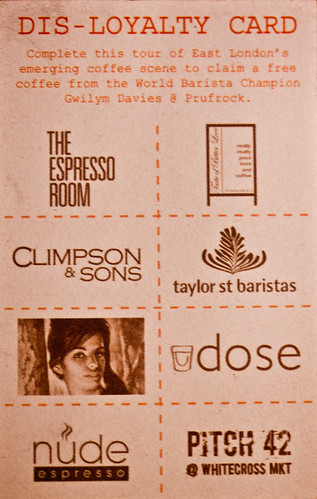
Gwilym Davies – you know, the current World Barista Champion – has come up with a rather splendid card: the disloyalty card.
The idea is simple: If you go and drink coffee at 8 interesting, quality focused cafes around (mostly) East London then he will say thank you by making you a coffee for free.
(click to embiggen)
I just think this is brilliant. There is no catch, it isn’t some cunning ruse to sell more coffee. It might work if one roaster supplied all the places on the card – but there is a complete mix from Burgil to Union, from Square Mile to Nude’s in house espresso. Gwilym just wants people to go and try coffee in different places.
This man is a great ambassador for coffee.
So swing by Prufrock Coffee in Present at 140 Shoreditch High Street, grab a card and then have a little tour of some great cafes around Central and East London. There is one of the best baristas in the world at the end of it, waiting to give you a delicious drink to say thank you. Superb.
If you enjoyed this then please share it:
Related posts:
- The wine model doesn’t work I think everyone in coffee knows deep down this is...
- Bristol Barista Jam Today Anette and I drove across to Bristol for a...
- Colombia 2007 – Bogota Back when I was in Moscow Jose Arreola asked me...
- WBC 2008 Well, where to begin? Copenhagen was not what I expected,...
- The Fair Trade Finish Line A little while ago my frustration with Cadburys advertising led...
Sounds like a silly idea to me - unless you've partnered with them before. But it's an original idea for sure.
Looking at the iPad app rollout, you can easily separate the digital wheat from the chaff in the content industries, and you can see those who are developing digital businesses and those who are trying to protect print margins and who see the iPad as a vertical, closed model to control and monetise content.
There are those who believe that they sell content and that they should be compensated for it. Just as with the music industry, they couch this in terms of repaying content creators, when it really is more about wistfulness for the days of double-digit profit margins.
Those who view their primary business as selling content believe that not only can they charge for it but that they can actually charge the same or more for it, just because it is on the iPad. Time, for example, is charging $4.99 a week for their iPad ‘magazine’.
Scott Karp, CEO of Publish2 and editor of Publishing2.0, put it as clearly as it needs to be put on Twitter:
Paying $4.99 for magazine on newsstand includes cost of printing/distribution. Now you pay for iPad instead, so magazine should cost less.
What do you get for $4.99 a week?
Unique interactivity including landscape and portrait mode, scroll navigation and customizable font size
Oh, I’ve never seen that in a mobile web browser, I say with incalculable levels of sarcasm. That’s like morons in the 90s having Java animation that you actually couldn’t do anything with and calling that interactivity. You think that’s insane and delusional, just wait, it gets even better! No content sharing on the app, which I’m assuming means you can’t bookmark or Tweet your favourite stories, and you’ll have to buy and download the app every single week. There is also no indication that they will charge for their now free iPhone app or their website.
Note to Time digital strategists: Sorry caching your site so I can take it with me when I’m on the move isn’t a feature worth your premium pricing. I do that now, and have done it for years, with an open-source app called Plucker and an aging Palm T3. I’m truly sorry. Do you actually use the internet or digital devices or do you just indulge your bosses’ angry fantasies about the good old days?
Let’s look to Rupert Murdoch’s proud paid content pioneer, the Wall Street Journal. What is the Wall Street Journal selling? The past. Alan Murray, deputy managing editor and executive editor, online for the Wall Street Journal, says on MarketWatch:
We have come up with a version of the Wall Street Journal on the iPad that I think is closest you get to a newspaper reading experience on a digital device.
To be fair to Murray, he goes on to say that anyone giving their content away for free on the web won’t be able to convert those readers on the web to paid readers on the iPad. Murray says:
You have these apps, but you also have a web browser. So I don’t see how any newspaper that is giving its content away for free on the web is going to be saved by the iPad because the iPad makes it easier to access that free content.
Unless the Wall Street Journal’s app not only delivers me a ‘newspaper reading experience’ (which I frankly am not missing anyway) but also picks my stocks for me so that I can retire next year, I’m not going to pay $17.99 a month for it when I can subscribe to their website for $1.99 a week. I didn’t work on a journalist’s salary and still manage to be in a financially secure position by giving money away to grumpy old media moguls like Murdoch.
Paul Kedrosky, venture capitalist and private equity investor who writes the blog Infectious Greed, said on Twitter:
Paying $17.29/mo for WSJ iPad app should disqualify you for something important, like being allowed to use money.
As I’ve said before, Murdoch for all of his brash brilliance has no understanding of the economics of digital businesses. I give him props for still having the power to shift the discussion, and I think that his paywall strategy at the Times might help it stem its £250,000 a day losses. However, his paywall strategy is a defensive move, not a long term strategy. Unless he starts building credible digitally-focused businesses as soon as the paywall brings in some cash to stabilise the business, it will be a brief pause on the path to collapse.
Now, let’s look at other strategies for the iPad. Let’s look at the FT. Robert Andrews, UK editor of paidContent, says that the FT secured sponsorship that allows it to offer its iPad app for free for two months, after which time they will shift to subscription model with the promise of additional features. Much cleverer.
Suw and I talk often that one thing really lacking when it comes to digital content is commercial experimentation. The FT securing sponsorship for a free app for two months is a good step at not only experimenting with content but also with payment models. The Economist earlier this year released a report on social networking, allowing users to download it for free and giving sponsor prominent credit for the offer. This is clever. Premium sponsorship opportunities for special content or services.
Look at the development thinking behind National Public Radio’s iPad app. They did market research and found that up to 5% of their audience were planning on buying an iPad. They knew what the opportunity was. They also used iPad development to improve the experience for visitors coming from search or social networking services, explains Kinsey Wilson, senior vice president and general manager of NPR Digital Media.
Compare the strategies and thinking. On the one hand we have a set of pricing models that deliver marginal value for premium prices and show very little that differentiate themselves from the web experience, although they expect to charge more. These pricing models are based on a sense of entitlement to set pricing as it was in the days of print. I won’t even call them strategies because they lack any kind of realistic strategic thinking.
On the other hand we have a set of strategic pricing structures. NPR takes a realistic look at the commercial potential, does market research and develops its app not just for a single device but also as a chance to make improvements to their overall service. The FT experiments not just with content but also with the commercial strategy.
In terms of who is positioning themselves for the future by delivering value to their audiences and experimenting with business models, it’s clear. If any company thinks that the iPad will allow them to rebuild the monopoly rent pricing structure of the 20th Century, then you’ve really fallen prey to the Steve Jobs’ reality distortion field, and you’ve blown yet another chance to build a credible digital business. However, I’ve got a game you might want to check out, Final Fantasy.
-->Tagged as: Apple, business models, iPad
Great article - whole-heartedly agree.
The Google guys had some fun porting Quake 2 over to dhtml5 - bit of a shoutout to Adobe here that they're not needed everywhere. I'm definitely going to try this on the iPad - but would still love for Apple to support flash on there in the meantime.
Here’s my fun fact for the day, provided courtesy of Robert Litan, who directs research at the Kauffman Foundation, which specializes in promoting innovation in America: “Between 1980 and 2005, virtually all net new jobs created in the U.S. were created by firms that were 5 years old or less,” said Litan. “That is about 40 million jobs. That means the established firms created no new net jobs during that period.”
Skip to next paragraph Fred R. Conrad/The New York Times
Thomas L. Friedman
Related
Times Topics: Unemployment
Message: If we want to bring down unemployment in a sustainable way, neither rescuing General Motors nor funding more road construction will do it. We need to create a big bushel of new companies — fast. We’ve got to get more Americans working again for their own dignity — and to generate the rising incomes and wealth we need to pay for existing entitlements, as well as all the new investments we’ll need to make. It was just reported that Social Security this year will pay out more in benefits than it receives in payroll taxes — a red line we were not expected to cross until at least 2016.
But you cannot say this often enough: Good-paying jobs don’t come from bailouts. They come from start-ups. And where do start-ups come from? They come from smart, creative, inspired risk-takers. How do we get more of those? There are only two ways: grow more by improving our schools or import more by recruiting talented immigrants. Surely, we need to do both, and we need to start by breaking the deadlock in Congress over immigration, so we can develop a much more strategic approach to attracting more of the world’s creative risk-takers. “Roughly 25 percent of successful high-tech start-ups over the last decade were founded or co-founded by immigrants,” said Litan. Think Sergey Brin, the Russian-born co-founder of Google, or Vinod Khosla, the India-born co-founder of Sun Microsystems.
That is no surprise. After all, Craig Mundie, the chief research and strategy officer of Microsoft, asks: What made America this incredible engine of prosperity? It was immigration, plus free markets. Because we were so open to immigration — and immigrants are by definition high-aspiring risk-takers, ready to leave their native lands in search of greater opportunities — “we as a country accumulated a disproportionate share of the world’s high-I.Q. risk-takers.”
In addition, because of our vibrant and meritocratic university system, the best foreign students who wanted the best education also came here, and many of them also stayed. In its heyday, our unique system also attracted a disproportionate share of high-I.Q. risk-takers to high government service. So when you put all this together, with our free markets and democracy, it made it easy here for creative, high-I.Q. risk-takers to raise capital for their ideas and commercialize them. In short, America had a very powerful, self-reinforcing engine for growing innovative new companies.
“When you get this happy coincidence of high-I.Q. risk-takers in government and a society that is biased toward high-I.Q. risk-takers, you get these above-average returns as a country,” argued Mundie. “What is common to Singapore, Israel and America? They were all built by high-I.Q. risk-takers and all thrived — but only in the U.S. did it happen at a large scale and with global diversity, so you had this really rich cross-section.”
What is worrisome about America today is the combination of cutbacks in higher education, restrictions on immigration and a toxic public space that dissuades talented people from going into government. Together, all of these trends are slowly eating away at our differentiated edge in attracting and enabling the world’s biggest mass of smart, creative risk-takers.
It isn’t drastic, but it is a decline — at a time when technology is allowing other countries to leverage and empower more of their own high-I.Q. risk-takers. If we don’t reverse this trend, over time, “we could lose our most important competitive edge — the only edge from which sustainable advantage accrues” — having the world’s biggest and most diverse pool of high-I.Q. risk-takers, said Mundie. “If we don’t have that competitive edge, our standard of living will eventually revert to the global mean.”
Right now we have thousands of foreign students in America and one million engineers, scientists and other highly skilled workers here on H-1B temporary visas, which require them to return home when the visas expire. That’s nuts. “We ought to have a ‘job-creators visa’ for people already here,” said Litan. “And once you’ve hired, say, 5 or 10 American nonfamily members, you should get a green card.”
We need health care, financial reform and education reform. But we also need to be thinking just as seriously and urgently about what are the ingredients that foster entrepreneurship — how new businesses are catalyzed, inspired and enabled and how we enlist more people to do that — so no one ever says about America what that officer says to Tom Cruise in “Top Gun”: “Son, your ego’s writing checks your body can’t cash.”
Nicholas D. Kristof is off today.Sign in to Recommend More Articles in Opinion » A version of this article appeared in print on April 4, 2010, on page WK9 of the New York edition.
couldn't agree more - stop the fearmongering and let people take risks - immigrants or Americans.
1.5", fully embroidered, Velcro-backed. Attach to your jacket, your backpack, or the lid of your over-clocked, battle-scarred laptop. Start a nerd sash!
That’s 4+ stops in one night for you!
I really love the colors that Foursquare...
A seventeen-inch length of two-inch wide, self-adhesive, loop-side, low-profile Velcro. The Laptop Sash sticks permanently...
Requirements: Able to turn a pile of loose electrons into a fully operating and styled...
A special shoutout for holding down 10 mayorships at once!
This is it, the drop-dead...
Requirements: Provide hardware, software, and telephone support for extended family computers and electronics. Voluntarily or...
You’ve checked into 50 different venues!
This is one of four Foursquare badges designed by...
Requirements: Correctly spell words that sound the same.
We’re making more of these, will be...
Follow us on twitter at
@nerdmeritbadges
Cool idea!